Caputo and Riemann-Liouville derivatives
Both time derivatives are symbolic markers. They record which derivative you want. The representation and formulation decide how it is computed. Orders are immutable and satisfy \(0<\alpha<1\).
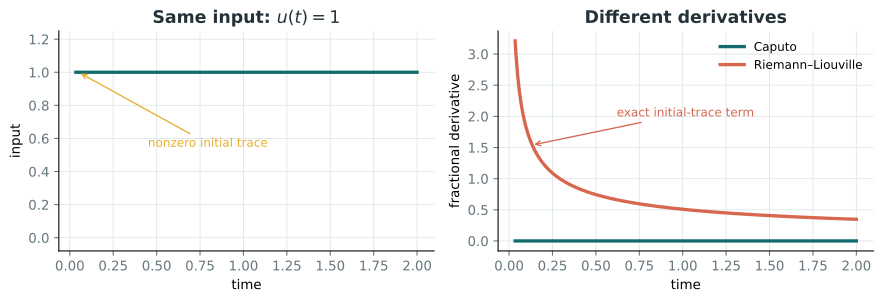
For the same constant input, Caputo annihilates the initial value while the Riemann-Liouville derivative retains its singular initial-trace term.
Caputo
For a sufficiently regular \(u\),
CaputoDerivative(u, alpha) marks this. The Caputo derivative of a constant
is zero, so classical initial data need no special treatment.
Riemann-Liouville
The supported left derivative with lower limit \(t_0\) is
and for a \(u\) with a classical trace at \(t_0\) it splits as
RiemannLiouvilleDerivative(u, alpha) approximates the Caputo part with the
chosen representation and adds the initial-trace term exactly. Unlike the
Caputo derivative, it does not annihilate a nonzero constant.
Construction snapshots \(t_0\) and \(u(t_0)\). reset(u0, t0=...) replaces both.
Evaluation at \(t_0\), arbitrary prehistory, and fractional-integral initial
data are not currently supported. The equivalence used here follows
Yuan, Gao, Xiu, and Shi (2020).
Markers must wrap the stepped field
Marker replacement happens before form compilation and differentiation, so the
marker has to sit directly on u. Fixed spatial UFL operators may surround
it:
Du = CaputoDerivative(u, alpha)
F_damping = b * inner(grad(Du), grad(v)) * dx
This is the weak form of \(-b\Delta D_C^\alpha u\). Wrapping a transformed
expression instead of u is currently unsupported.
The justification is commutation. Let \(L\) be a linear, time-independent spatial operator on a fixed domain. If \(u\) is regular enough for \(L\) to pass through the defining integral, then
and for the Riemann-Liouville marker the classical trace must additionally lie in the domain of \(L\). Time-dependent or nonlinear spatial operators, moving domains, and incompatible boundary realizations break this and are unsupported.
Multi-term damping
With fixed indicator functions \(\chi_m(x)\) over a material partition, the recurrence path supports several orders in one residual:
Each order owns its own diffusive representation. All terms share the field and the time increment. The head demos in the Gallery use this form.